
Maureen

Maureen
I don’t know what time it was, but it felt late. Some drowsy, muffled time in those hours that are mysterious or frightening to children who have no knowledge of what the grownups do after dark. I was halfway down the stairs before I was shooed sharply and efficiently back to bed. My eyes, heavy with sleep, could not see you clearly.
What drew me was the crying. None of the other grown-ups ever cried. No one in this house ever cried – except me. I cried with rage; I cried with temper until Nanna would send me out into the hall. Daddy said he would give me a good hiding.
I didn’t want to be shut in that cupboard under the stairs, next to the Hoover with its beige fabric bag and oblong monster mouth, drooling its angry light. A light that grimaced at the space under the chairs where the burgundy carpet never saw daylight and which no foot ever stepped upon. So I learned to cry no longer than a few seconds, a habit I still keep.
Hearing you sobbing and distressed, a grown-up, was queer indeed...
I wondered later why you had rushed to your Aunt instead of your mum. You looked like your mum, more so as you aged, only sassier, with eyes more welcoming and a gently wry smile. You might have had an engaging warmth but life had disappointed you much too early on in the race.
I came to your house once. I waited in a room of awkward girls. Your girls were unknown to me and seemed as though they came from another age, with their dark silken plaits and round faces. Girls who were taller than me, quieter and more serious. Girls in the first blush of their womanhood. Girls that knew secrets I was not yet old enough to share or to join in with. Girls that were already hesitant and suspicious. The eldest girl had hair that hung loose in soft waves, I had not seen hair this long before, untamed by braids like her sisters; the pre-Raphaelite contrasted with the Puritanical.
The room was dark. The velvet curtains were heavy and faded, yet there was an air of quality and richness but from long ago and now only hinted at. A room that might reveal the stories, (which some families have), yet choose to remain unspoken and unknown, coded and recorded within the patterns of the wallpaper.
Silently keeping its counsel at the centre, stood a large piano, cypher unlocked, amidst the untidy, musty and unloved room.
A room not plumped and polished like Nanna’s but more bohemian, and therefore perhaps a little more honest.
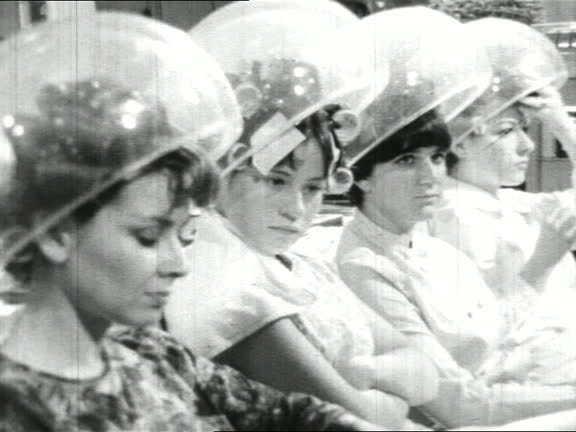
You were a hairdresser in a tiny salon on a corner of the main high road. Nanna and her sisters all came to you once a week for their shampoo and set. I never saw Nanna wash her own hair. She would take an oval brush briskly to the nape of her neck. A few swift strokes under and upward, a pat to both sides and held by a generous spray of Harmony or Silverkrin.
That was the total of Nanna’s toilette. If we were going out she would allow herself, ‘just a little bit of scent’, as though it were pure gold that she sprayed into the air.
I watched you teasing the hair around the rollers with your tail comb, nimbly wielding its sharp metal point. Your fingers were industrious and practical, not attractive; devoid of paint and manicure, perhaps they revealed your true nature; your sensuousness had long been abandoned in favour of independence and self-sufficiency.
Your fingers, like your heart – glimpsed that night – had become dry and worn, chemically eroded like the over-processed hair, regularly beaten into submission by the steely tail comb. As you aged your hair hung limp and without body – tired I imagine – like your hardworking soul.
As you deftly lined the rollers, pulling tight the sagging scalps, you whispered the latest gossip into the eager receiving ears of the headscarfed ladies who came each week.Your voice was soft and lisping, with the occasional rounded vowel of the military middle classes. I loved to sit and listen to you, you were kind to me, and you noticed me.
It was a place for the women only and I was allowed to be there, it was my introduction and my induction into the world of beauty and understated glamour. However, you didn’t speak with malice, rather you were the reporter of news; small factoids delivered without judgement yet knowing every detail.
The titbits made all the sweeter with coffee and chocolate or biscuits. My Nanna and her sisters came from the age of baking, afternoon tea and ‘elevenses’. This was mid - morning coffee always made with boiled milk and accompanied with a saucer of two biscuits.
The sisters came together every Friday, having survived the ordeal of the demi-wave perm and the slow roasting under the drying hood. Do you remember – always fish for dinner on a Friday?
They met for their weekly game of cards — a test of wits, sisterly competitiveness, and lovingly barbed humour. Each took a turn to hostess and to bake. They were all so different: Nanna, the quiet, patient one; your mum, outspoken, with piercing eyes that were just a little scary; and their sister, a queen of dry wit whose razor tongue could slice you in half.
Sudden shrieks and cackles cawed from the trio gathered around the faded yellow Formica tabletop — the table that was an ironing board by day, dinner table at six, and card table by night.
Was it just tea and boiled fruit cake they shared, or did they treat themselves to a sherry — or perhaps the thick, creamy treacle of a glass of Baileys?
That’s how we were connected; your mum was my Nanna’s sister – one branch of the great ‘Tree of Seven’ that we all propagated from.
I knew your mum better than I knew you. I thought she seemed cross and short-tempered, though in truth I never saw evidence of her anger but she was often impatient and brutally blunt. She made my wedding dress and all six bridesmaids’ dresses from beautiful watermarked taffeta.
She was very skilled at her craft. Clearly her creativity was passed down to you but beyond this I know nothing of what you shared – how you spoke to each other, how you felt.
I know little of mothers and daughters; another secret society that I have been denied entry to.
Nanna was soft, calm and comforting. Perhaps that’s why you chose to run to her that night. She was the same for both of us – someone who would never ask you to speak shameful secrets or whisper words that might paint pictures of violence, drama and fear.
She would never ask awkward questions lest they cause you to relive the shame and humiliation of loving someone who hurts you.
I don’t know what happened after I went back to my bed. You were not there in the morning and I know you were not under the stairs next to the beige Hoover bag.
Apparently, your husband had given you your good hiding under your own stairs before you came.
You must have cried too long.
.